Architecture without shadow paths
No Plant Is Average (AI for food security).
One Postgres ledger, one job semantics, one set of mode gates, whether the caller is an MCP agent or the grower's dashboard. Built for transparent food production and hardware you can maintain; normative engineering detail is provided in commercial documentation aligned with your agreement.
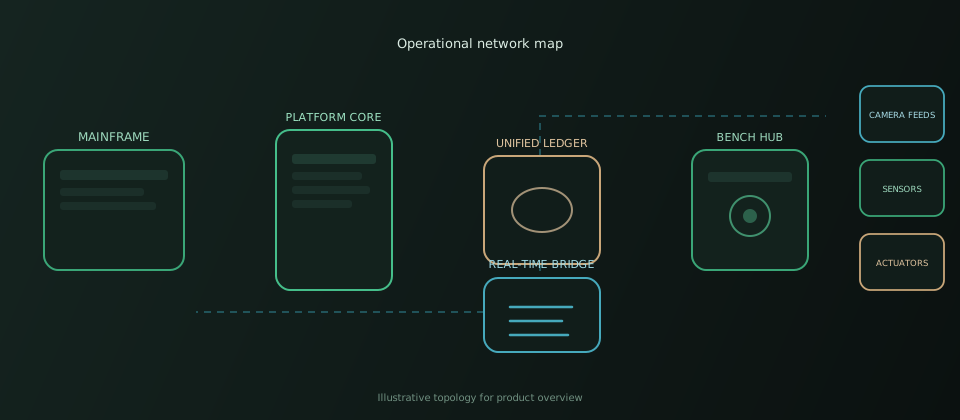
Connected grow system
How every bench stays connected
A simple map of how yieldAI links planning, records, and bench control into one connected operating system for your greenhouse.
Product explainer
Watch yieldAI in action
A concise walkthrough of how yieldAI connects planning, sensing, and reliable actuation on every bench.
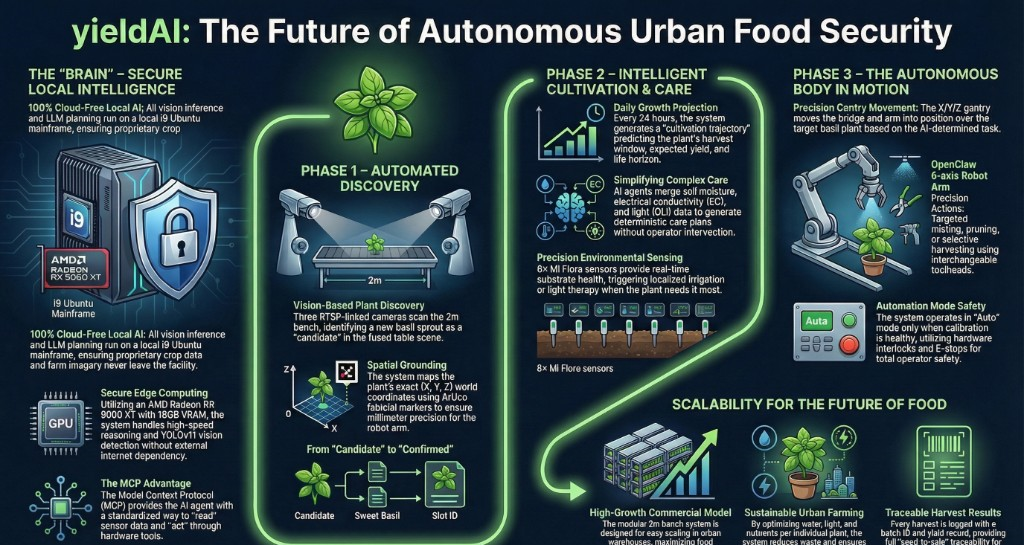
System blueprint
From discovery to harvest impact
A visual map of the full product journey: local intelligence, bench automation, and measurable food outcomes.
Click image to enlarge
System flow
From insight to action, in five steps
This is a quick visual tour you can control. Use Prev and Next, or pause auto-play. The panel on the right highlights each part of the product as it works.
Steps advance automatically every few seconds while playing. Auto-advance is off when your system prefers reduced motion. Use Prev and Next.
1 · Grower touchpoints
An MCP-capable agent host and the operator dashboard are peers: both call the same tools, pass the same validation, and respect the same automation mode gates - no parallel control plane.
2 · Platform records everything
The MCP server, job scaffolding, and domain services record jobs, plant state, and telemetry in PostgreSQL. Anything the UI or agent shows should trace back to these rows.
3 · Reliable command delivery
Motion intent and fast telemetry cross to the table hub over MQTT (or your agreed bridge). The mainframe publishes; the gantry-side controller executes within policy.
4 · Bench intelligence in the real world
Cameras (RTSP), soil and climate probes, pumps, valves, and motion hardware live at the bench. They are the physical half of the closed loop.
5 · One source of truth
Telemetry ingest (today) and vision workers (roadmap) fold results into Postgres. The dashboard and MCP agent both read that ledger - so suggestions, audits, and harvest stories stay aligned.
Platform foundation
One platform for growers and automation
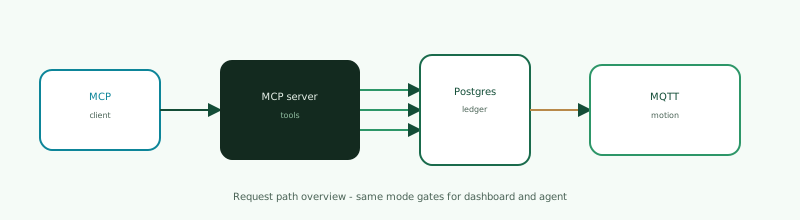
An LLM host (production: yieldAI Agent, OpenClaw-powered; development: Cursor or another MCP client) talks to the yieldAI MCP server over stdio or your chosen transport. Tools call into domain code that reads and writes PostgreSQL and publishes motion intent to MQTT for the table-side controller.
The greenhouse dashboard (first-party LAN UI) is a peer at the UX layer: it should use the same read models and the same orchestration and ABG_AUTOMATION_MODE gates as MCP - not a shadow control plane.
Data backbone
Trusted records for every bench
PostgreSQL
Plants, locations, telemetry, media index, jobs, calibration, robot snapshots - authoritative state for agents and UI.
MQTT
Motion commands and status between mainframe bridge and ESP32 (or similar) on the gantry path; optional job topics for HUDs.
Vision (roadmap)
Target: RTSP ingest, models, fused table scene - heavy work off the MCP hot path; results land in DB for tools and dashboard when the worker ships.
Dashboard API
Thin HTTP (or SSR) over McpDataFacade-style services;
incremental delivery per the operator-dashboard specification.
Operational safety
Human-in-loop control
Long-running work runs through an orchestration job state machine: pending, running, awaiting human confirmation, completed or failed - with every transition auditable. Manual, assist, and auto automation modes decide whether actuation tools run live, dry-run only, or require an explicit human step.
Details are normative in the implementation plan (Parts 13-14, Appendix F). The website only summarizes; integrators work from the controlled product documentation supplied with your agreement.
Explore more
Product documentation
Implementation plan
Parts, slices, MCP manifest, appendices - canonical build order for the platform.
Dashboard specification
Operator UI scope, twin definition, API sketch, security notes.
Project master
Hardware narrative, firmware interfaces, environment assumptions.