Architecture without shadow paths
AI for the people, structured to feed the people.
One Postgres ledger, one job semantics, one set of mode gates, whether the caller is an MCP agent or the grower’s dashboard. Built for transparent food production and hardware you can maintain; normative engineering detail is provided in commercial documentation aligned with your agreement.
IoT view
Devices, bridges, and the LAN edge
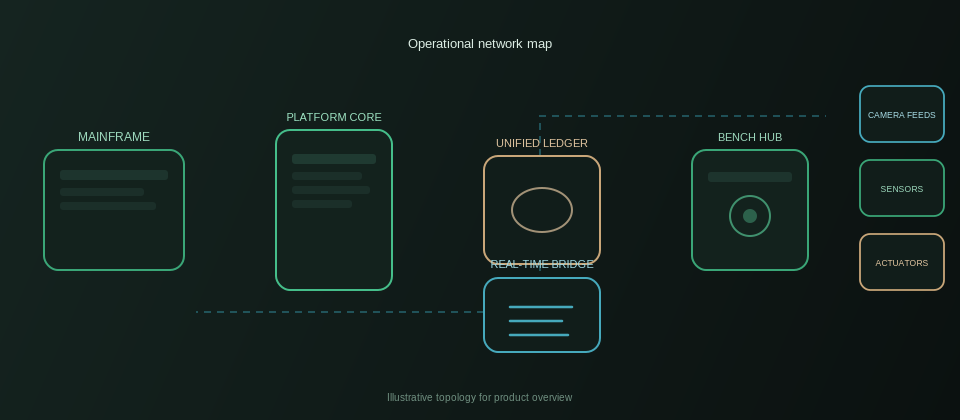
A control-room style map of how the mainframe, MCP core, ledger, MQTT bridge, table hub, and bench I/O relate on your network. Same story as the text below - just drawn like an instrumentation panel.
Walkthrough
How data and motion move (step by step)
This is not a hosted video - it is a lightweight, on-page tour you can read at your own pace. Use Prev and Next, or pause the auto-advance. The panel on the right highlights the part of the stack each step talks about.
Steps advance automatically every few seconds while playing. Auto-advance is off when your system prefers reduced motion. Use Prev and Next.
1 · Experience layer
An MCP-capable agent host and the operator dashboard are peers: both call the same tools, pass the same validation, and respect the same automation mode gates - no parallel control plane.
2 · Core writes truth
The MCP server, orchestration, and domain services record jobs, plant state, and telemetry in PostgreSQL. Anything the UI or agent shows should trace back to these rows.
3 · MQTT to the wet edge
Motion intent and fast telemetry cross to the table hub over MQTT (or your agreed bridge). The mainframe publishes; the gantry-side controller executes within policy.
4 · Sensors, vision, actuators
Cameras (RTSP), soil and climate probes, pumps, valves, and motion hardware live at the bench. They are the physical half of the closed loop.
5 · Same ledger, full loop
Vision workers and ingest paths fold results back into Postgres. The dashboard and MCP agent both read that ledger - so suggestions, audits, and harvest stories stay aligned.
Logical view
Agent, tools, and data
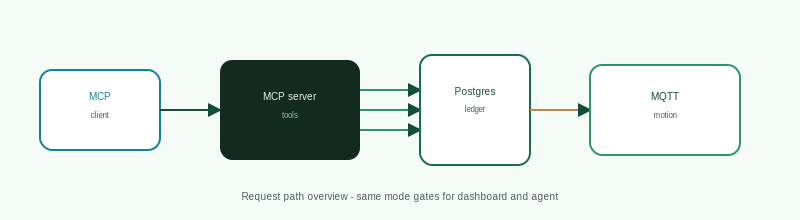
An LLM host (yieldAI Agent, OpenClaw-class stack, or another MCP client) talks to the yieldAI MCP server over stdio or your chosen transport. Tools call into domain code that reads and writes PostgreSQL and publishes motion intent to MQTT for the table-side controller.
The greenhouse dashboard (slice 14) is a peer at the UX layer: it should use the same read models and the same orchestration and ABG_AUTOMATION_MODE gates as MCP - not a shadow control plane.
Data path
Where truth lives
PostgreSQL
Plants, locations, telemetry, media index, jobs, calibration, robot snapshots - authoritative state for agents and UI.
MQTT
Motion commands and status between mainframe bridge and ESP32 (or similar) on the gantry path; optional job topics for HUDs.
Vision worker
RTSP ingest, models, fused table scene - heavy work off the MCP hot path; results land in DB for tools and dashboard.
Dashboard API
Thin HTTP (or SSR) over McpDataFacade-style services;
incremental delivery per the operator-dashboard specification.
Safety
Modes and jobs
Long-running work runs through an orchestration job state machine: pending, running, awaiting human confirmation, completed or failed - with every transition auditable. Manual, assist, and auto automation modes decide whether actuation tools run live, dry-run only, or require an explicit human step.
Details are normative in the implementation plan (Parts 13–14, Appendix F). The website only summarizes; integrators work from the controlled product documentation supplied with your agreement.
Read next
Specifications
Implementation plan
Parts, slices, MCP manifest, appendices - canonical build order for the platform.
Dashboard specification
Operator UI scope, twin definition, API sketch, security notes.
Project master
Hardware narrative, firmware interfaces, environment assumptions.